Age-related macular degeneration (AMD)
AMD affects the macula, the small central part of the retina that gives us sharp, detailed vision for reading, recognising faces and seeing straight ahead.
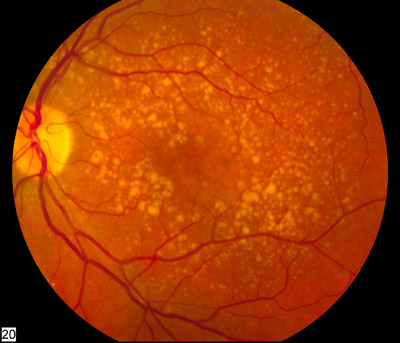 Fundus photograph of intermediate AMD. Credit: National Eye Institute, NIH; Wikimedia Commons, public domain.
How AMD affects vision
AMD can blur the centre of vision but does not usually cause complete blindness because side vision is generally retained. It can develop slowly or, in some cases, change more quickly. One eye may be affected more than the other, so a change can be easy to miss at first.
Dry and wet AMD
- Dry AMD is the more common form. It is associated with deposits called drusen and gradual thinning or damage in the macula. Early dry AMD may have no symptoms.
- Wet AMD occurs when abnormal blood vessels grow under the macula and leak fluid or blood. It can cause faster loss of central vision and needs prompt assessment.
Symptoms that need attention
- Straight lines looking wavy, bent or distorted
- A blurred, grey or blank area in central vision
- Difficulty recognising faces, reading or seeing fine detail
- Colours appearing less bright or difficulty in low light
Contact an eye specialist promptly if straight lines suddenly look wavy or you notice a new central blur or blank patch. These can be signs of wet AMD.
Testing and monitoring
AMD is found through a dilated eye examination. Your clinician may also use optical coherence tomography (OCT), a painless scan that shows the layers of the retina. Home monitoring may be advised for some patients; follow the method and schedule recommended by your eye-care team.
Managing AMD
Management depends on the type and stage. Early AMD is usually monitored. For selected people with intermediate AMD or late AMD in one eye, AREDS2 supplements may reduce the risk of progression; they are not appropriate for every stage or every person, so ask before starting them. Wet AMD is commonly treated with medicines injected into the eye to control leaking blood vessels, with treatment frequency based on response.
Not smoking, regular physical activity, healthy blood pressure and cholesterol, and a diet including leafy greens and fish can support general eye health. If vision is affected, low-vision aids and rehabilitation can help maintain independence.
Clinical information
Adapted from the National Eye Institute AMD guide and its AREDS2 guidance.